By the Design Team at Elegante Interiors | 14 Years Combined Experience | Last Updated: May 2026
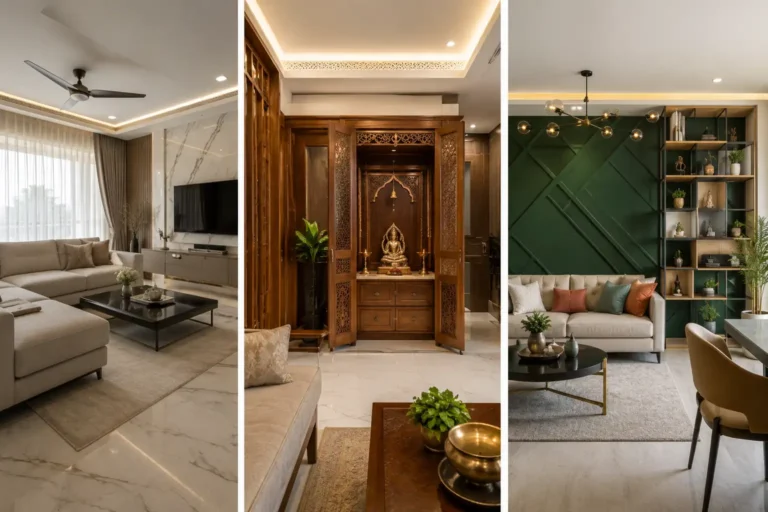
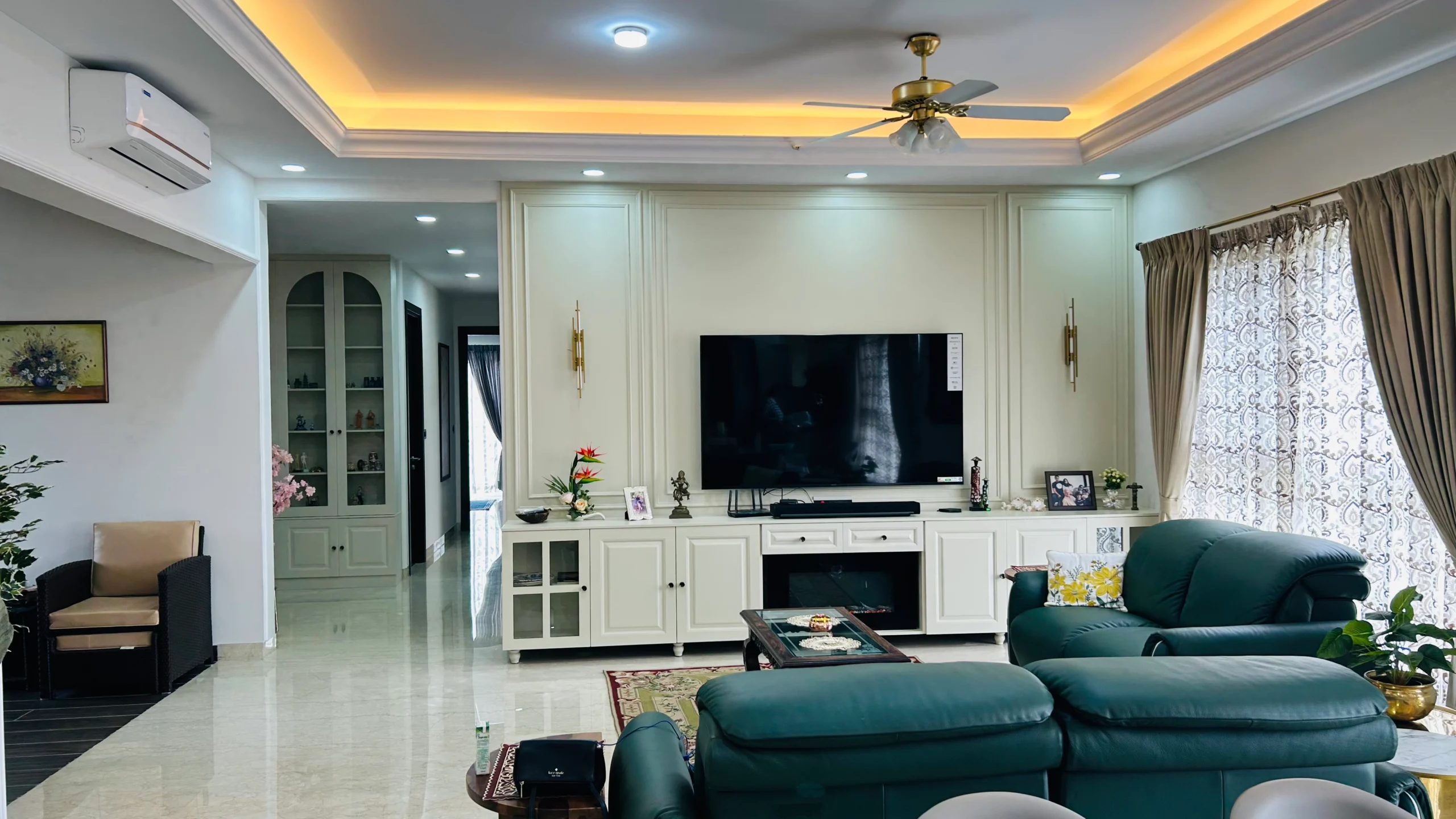
This is a story about two apartments. Same building. Same floor plan. Same 2,100 sq ft 4BHK layout. Same tower. Literally the same corridor Flat 1204 and Flat 1205 in a premium gated community in Whitefield,Bangalore. Flat 1204 belongs to Vikram a CTO at a SaaS company. Budget: ₹40 lakhs. Nocompromises. Italian stone. Imported hardware. Custom everything. The works.
Flat 1205 belongs to Nikhil a senior engineering manager at the same company. Budget:₹16 lakhs. Tight. Non-negotiable. Every rupee had to fight for its place. Both hired Elegante Interiors. Both wanted the same thing: a modern, warm, sophisticatedhome that feels designed not assembled.
Here’s what happened when two neighbours with a ₹24 lakh budget gap asked the same design team to create the same feeling. The result surprised everyone. Including us.
The Challenge We Gave Ourselves
When Nikhil approached us three weeks after Vikram’s design was finalised he said
something that became the thesis of his entire project-
“I’ve seen Vikram’s 3D renders. I love that look. I know I can’t have those materials. But I
don’t want anyone walking into my apartment and immediately thinking ‘this is the budget
version. ” Is that possible?” It’s a question we get every month at Elegante. And the honest answer is: yes. With conditions.
You can’t replicate ₹40 lakh materials at ₹16 lakhs. That’s physics, not design. Italian
Statuario marble costs what it costs. German hinges cost what they cost. Imported veneer
costs what it costs. But here’s the insight that most interior designers in Bangalore either don’t understand or
don’t want you to know: 80% of how a room “feels” comes from design decisions that cost the same at any budget.
Colour palette. Proportion. Lighting temperature. Negative space. Hardware finish consistency.
Ceiling profile. Sightline planning. These are design intelligence decisions, not
material cost decisions. They cost the same whether you’re spending ₹16 lakhs or ₹60
lakhs. The remaining 20% the material quality, the surface finish, the tactile experience of
touching a countertop or opening a drawer that’s where the budget shows. But only to
someone who’s actively looking for it. This blog is about that 80/20 split. Room by room. Rupee by rupee.
The Ground Rules: What Both Apartments Had in Common
Before we get into the differences, here’s what was identical:
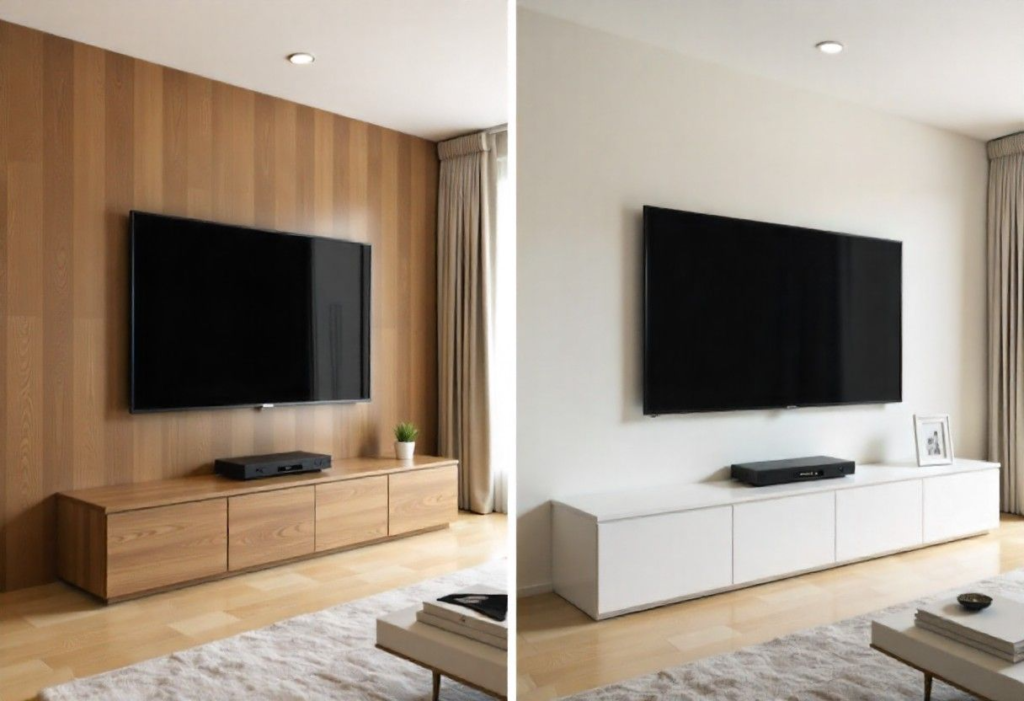
Design language: Warm minimalism. Neutral palette with matte black hardware accents.
Wood-tone laminates. Clean lines. No ornate carvings, no heavy mouldings, no traditional
elements.
Colour palette: Warm Linen walls (Asian Paints) in both apartments. Soft Clay accent walls
in both master bedrooms. Charcoal Grey feature walls behind both TV units. Identical paint
across both homes. Paint costs the same regardless of what furniture you put in front of it.
Layout and space planning: Identical floor plans. Same furniture placement logic. Same
sightlines from the entrance. Same false ceiling profiles. Same lighting point locations. We
didn’t change a single spatial decision between the two apartments.
Lighting colour temperature: 3000K warm white throughout both apartments. The colour
of light affects how a room feels more than almost any material choice. This was
standardised.
Hardware finish: Matte black handles, pulls, and accessories in both apartments.
Consistency of hardware finish is what makes a home feel “designed.”
This was non-negotiable at both budgets. These shared decisions, all free or near-free, are the reason both apartments feel the same from a 5-foot viewing distance.The differences only emerge when you touch, open, and inspect.
Let’s get into those differences.
Room 1: The Modular Kitchen Where the Biggest Budget Gap Lives
The kitchen is always the most expensive room in any Bangalore apartment. It’s also where the material gap between premium and budget is most pronounced — because kitchens endure daily heat, moisture, impact, and chemical exposure.
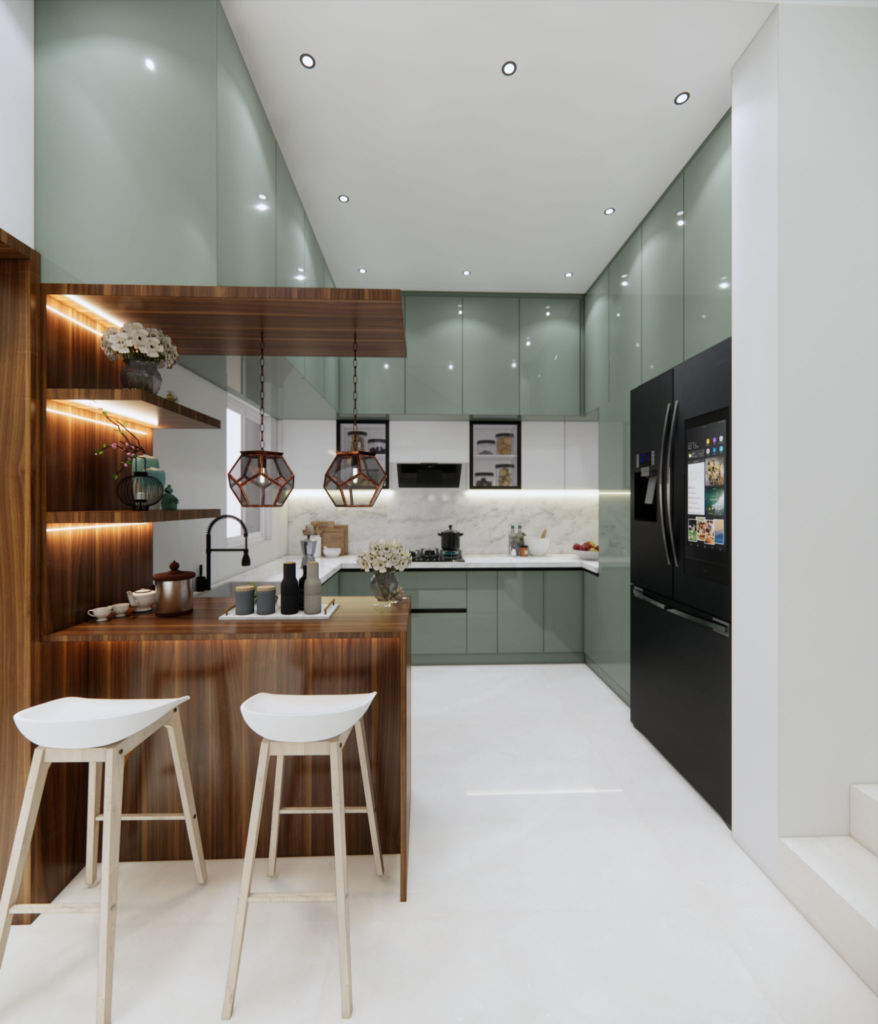
Vikram’s Kitchen (₹40L Budget): ₹9,80,000
| Component | Specification | Cost (₹) |
| Carcass | Marine plywood (BWP grade, 710+ density, IS 710 certified) | 2,40,000 |
| Shutters | Italian PU-painted finish in Sage Grey, matte. Spray-painted in 8 coats with hand-sanded finish between each coat | 2,85,000 |
| Countertop | Imported Calacatta quartz, 30mm edge, waterfall edge on island | 1,45,000 |
| Backsplash | Imported porcelain slab (bookmatched), floor-to-wall-unit coverage | 65,000 |
| Hardware | Blum Legrabox drawers, Blum Aventos HF lift-ups, Blum Servo-Drive (touch-to-open) | 1,20,000 |
| Accessories | Blum Orga-Line internal organisers, pull-out pantry (Vauth-Sagel), magic corner (Hafele) | 85,000 |
| Sink + Tap | Franke undermount sink, Grohe pull-down mixer tap | 42,000 |
| Chimney + Hob | Faber 90cm, 4-burner hob (Elica) | 48,000 |
| Kitchen Total | ₹9,80,000 |
Nikhil’s Kitchen (₹16L Budget): ₹3,65,000
| Component | Specification | Cost (₹) |
| Carcass | BWR plywood (710 density, IS 303 certified) — not marine grade, but fully moisture-resistant for Bangalore’s humidity | 1,45,000 |
| Shutters | Acrylic finish in Sage Grey, matte. Factory-pressed — not hand-painted, but visually near-identical from 2 feet | 95,000 |
| Countertop | Indian engineered quartz, Calacatta pattern, 20mm edge, straight edge (no waterfall) | 55,000 |
| Backsplash | Indian ceramic tiles in large-format 600x600mm, laid in a bookmatched pattern to mimic the porcelain slab effect | 18,000 |
| Hardware | Hettich InnoTech drawers, Hettich Aventos HK-S lift-ups, soft-close (manual open, not touch-to-open) | 42,000 |
| Accessories | Hettich internal organisers, pull-out pantry (Hettich Cargo), wire corner unit | 35,000 |
| Sink + Tap | Carysil undermount sink, Jaquar pull-down mixer | 18,000 |
| Chimney + Hob | Kaff 90cm, 4-burner hob (Kaff) | 28,000 |
| Kitchen Total | ₹3,65,000 |
The Kitchen Verdict: ₹6,15,000 Difference
What you can see from 5 feet: Almost nothing. Same Sage Grey colour. Same clean, handleless aesthetic (both use profile handles integrated into the shutter edge). Same layout. Same backsplash pattern. Same countertop colour.
What you can feel when you use it: The difference is real. Vikram’s Blum drawers glide with a buttery, dampened precision that Hettich InnoTech can’t quite match. His PU-painted shutters have a depth and warmth that acrylic finishes — as good as they are — can’t fully replicate. His Grohe tap has a weight in the hand that Jaquar doesn’t. His countertop edge has a 30mm thickness and a waterfall cascade that signals investment.
Our honest assessment: For daily cooking performance, Nikhil’s kitchen is 95% as functional as Vikram’s. The Hettich hardware is excellent — rated for 50,000+ cycles, backed by a 10-year warranty. The BWR plywood handles Bangalore’s humidity perfectly. The Indian quartz looks virtually identical to imported Calacatta.
The 5% gap is in tactile luxury — the feel of the drawer, the weight of the tap, the depth of the painted shutter. If you cook every day and consider the kitchen the heart of your home, that 5% might be worth ₹6 lakhs to you. If you don’t, it isn’t.
Room 2: The Living Room — Where Design Intelligence Closes the Gap
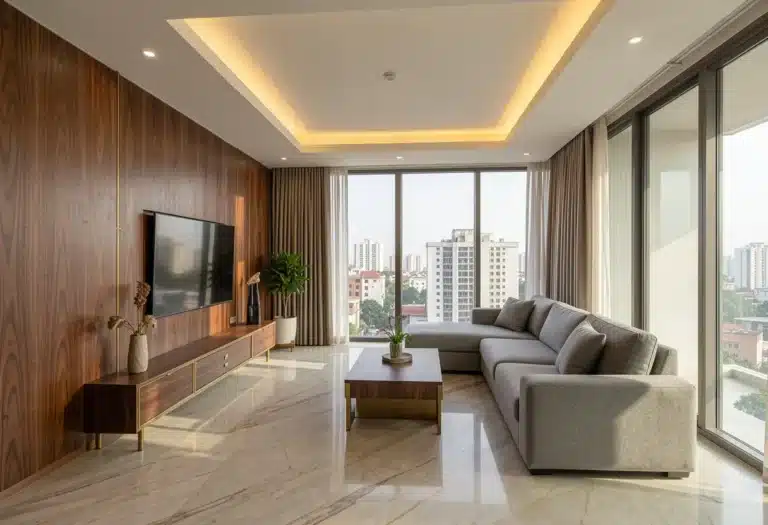
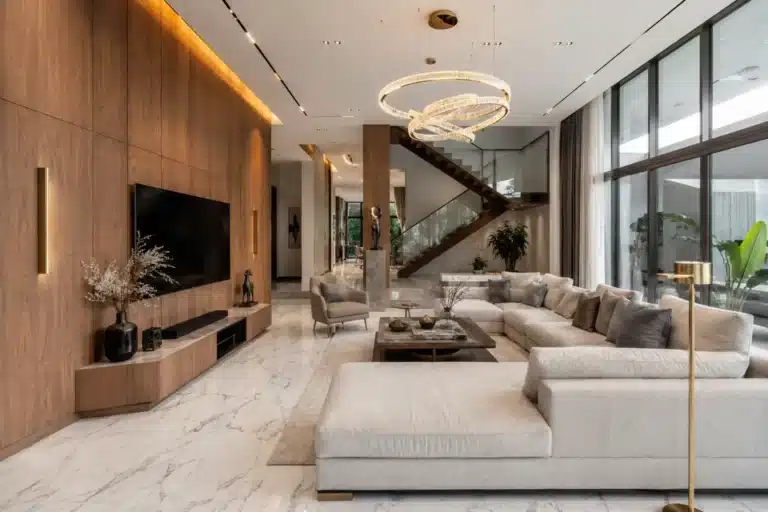
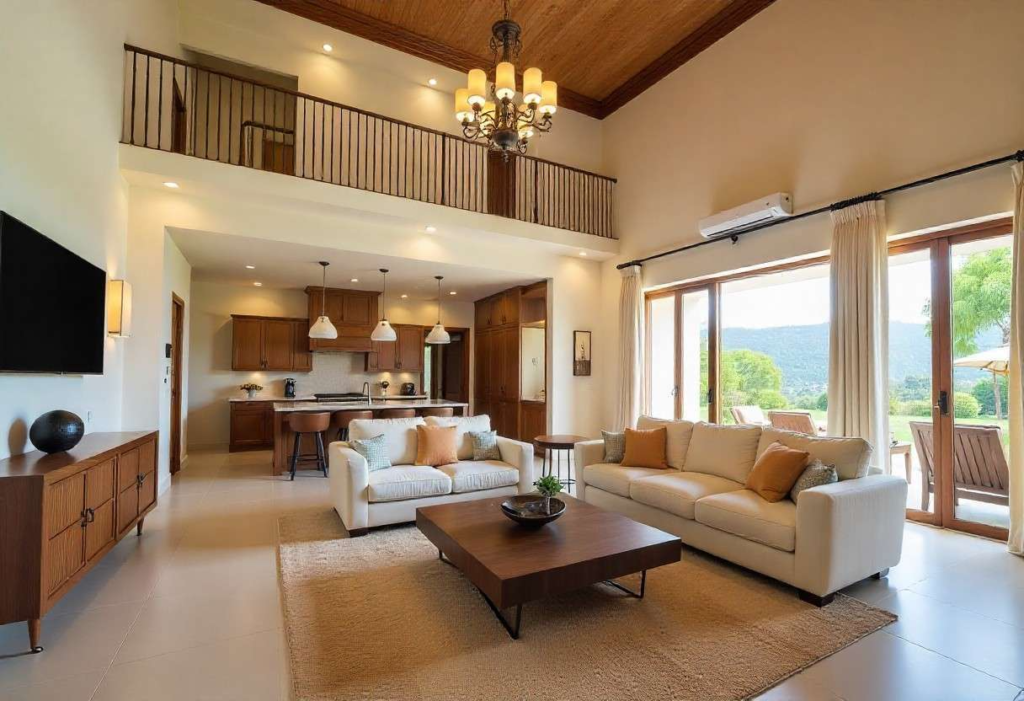
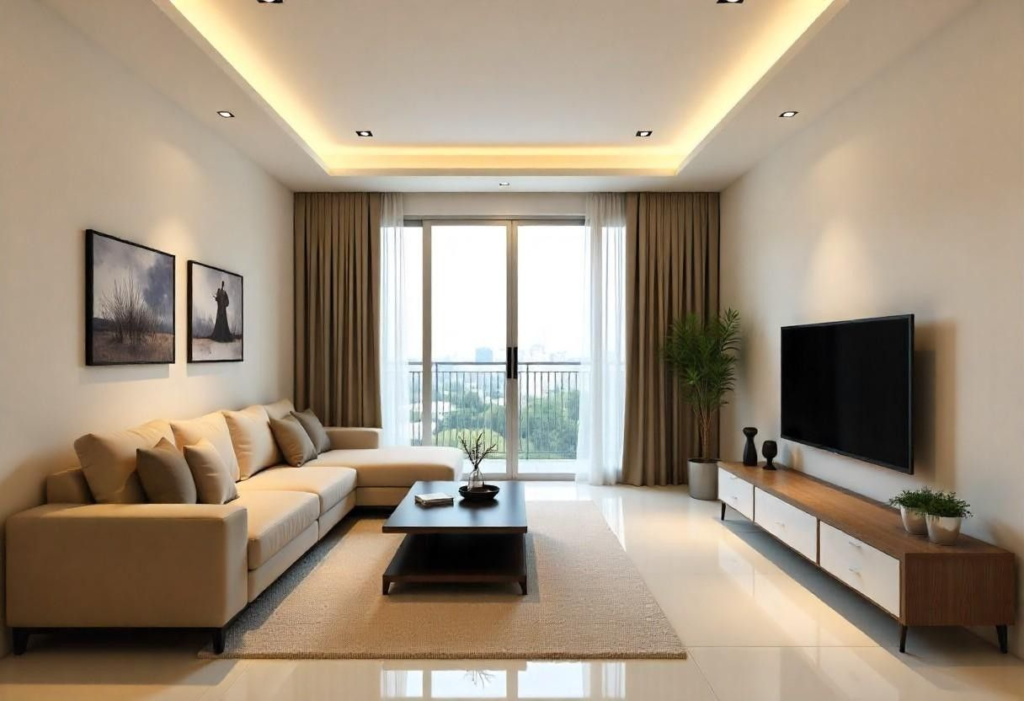
This is the room where the budget difference nearly disappears. Because the living room is primarily defined by spatial design, lighting, and one feature wall — not by the grade of plywood hidden inside a cabinet.
Vikram’s Living Room: ₹6,20,000
| Component | Specification | Cost (₹) |
| TV unit | Custom walnut veneer with book-matched grain, integrated cable management, push-to-open base unit, back-lit display niches, PU-painted floating shelves | 1,85,000 |
| Feature wall | Italian porcelain slab (3200x1600mm), Statuario pattern, full-height behind TV | 1,20,000 |
| False ceiling | Multi-layered stepped profile with peripheral cove, recessed downlights, 3 lighting zones (full, ambient, accent) on separate switches | 1,15,000 |
| Sofa set | Custom-upholstered 3+1 in Italian leatherette, solid teak frame | 1,10,000 |
| Lighting fixtures | Imported pendant (dining), track lights (accent wall), custom LED profiles | 55,000 |
| Curtains + blinds | Motorised sheer + blackout combination, imported fabric | 35,000 |
| Living Room Total | ₹6,20,000 |
Nikhil’s Living Room: ₹2,45,000
| Component | Specification | Cost (₹) |
| TV unit | Walnut-tone laminate finish with matching grain direction, integrated cable management, push-to-open base unit, back-lit display niches (same LED strip), painted floating shelves | 68,000 |
| Feature wall | Back-painted glass (Charcoal Grey) + wooden fluted panel on either side. Different material, same visual weight. The fluted panel adds texture and warmth that photographs identically to the porcelain slab | 35,000 |
| False ceiling | Same stepped profile, same cove, same downlight positions. Identical Gyproc board. Same 3 lighting zones on separate switches. The ceiling is physically the same — gypsum is gypsum | 95,000 |
| Sofa set | Custom-upholstered 3+1 in premium Indian leatherette, kiln-dried hardwood frame | 65,000 |
| Lighting fixtures | Indian-sourced pendant (same brass finish, similar silhouette), track lights (same brand), LED profiles (identical) | 28,000 |
| Curtains + blinds | Manual sheer + blackout combination, Indian fabric (same weave weight) | 12,000 |
| Living Room Total | ₹2,45,000 |
The Living Room Verdict: ₹3,75,000 Difference
What you can see from 5 feet: Remarkably little. The false ceiling is physically identical. The lighting is the same temperature, same positions, same zoning. The TV unit has the same silhouette, the same back-lighting, the same push-to-open mechanism. The fluted panel in Nikhil’s apartment actually photographs better than Vikram’s porcelain slab in many lighting conditions because the vertical grooves create shadow play that flat stone doesn’t.
Where the gap shows: The sofa. Sit on both, and you’ll feel the difference in frame rigidity, cushion density, and leatherette grain quality. Vikram’s Italian leatherette ages better — it develops a soft patina over years. Nikhil’s Indian alternative will need reupholstering in 5–7 years.
The feature wall is the other tell. Vikram’s Italian porcelain has a depth, translucency, and veining that back-painted glass simply can’t replicate when you’re standing right next to it. But across the room — from the sofa, where you actually sit and look at the wall — the visual impact is equivalent.
The design trick we used: We flanked Nikhil’s back-painted glass with fluted wooden panels. This breaks up the visual plane, adds texture and warmth, and directs the eye away from comparing the flat glass to stone. The total cost of glass + fluted panels was ₹35,000 vs Vikram’s ₹1,20,000 porcelain slab. Same wall. Same impact. ₹85,000 saved through design intelligence.

Room 3: Master Bedroom — The Wardrobe Is Where You’ll Spend or Save the Most
Vikram’s Master Bedroom: ₹5,40,000
| Component | Cost (₹) | Key Specification |
| Wardrobe (floor-to-ceiling, sliding, 10ft wide) | 2,80,000 | Imported lacquer-finished shutters, Blum soft-close rail, mirror panel, sensor-activated internal lighting, leather-lined jewellery drawer, motorised tie rack |
| Bed-back panel | 85,000 | Upholstered in suede-finish imported fabric, floor-to-ceiling, with integrated bedside reading lights and concealed power sockets |
| False ceiling + lighting | 75,000 | Peripheral cove with dimmable warm LED, 2 bedside pendant drops, star-point fibre optic accent |
| Wallpaper accent wall | 45,000 | Imported Italian textured wallpaper, silk-finish |
| Curtains | 28,000 | Motorised, imported blackout fabric |
| Dressing unit | 27,000 | Custom PU-painted vanity with lighted mirror |
| Bedroom Total | ₹5,40,000 |
Nikhil’s Master Bedroom: ₹2,10,000
| Component | Cost (₹) | Key Specification |
| Wardrobe (floor-to-ceiling, sliding, 10ft wide) | 1,15,000 | Laminate-finished shutters (same colour tone), Hettich soft-close rail, mirror panel, manual LED strip inside (sensor-less — switch-activated), standard jewellery tray, standard tie section |
| Bed-back panel | 35,000 | Upholstered in premium Indian fabric (same visual texture), floor-to-ceiling, with integrated reading lights and concealed sockets (identical electrical setup) |
| False ceiling + lighting | 65,000 | Same peripheral cove with dimmable LED. Pendant drops replaced with recessed adjustable spots (₹8,000 cheaper, same lighting effect). No fibre optic accent |
| Wallpaper accent wall | 12,000 | Indian-manufactured textured wallpaper in the same Sage Green tone |
| Curtains | 8,000 | Manual blackout, Indian fabric |
| Dressing unit | 18,000 | Laminate-finished vanity with lighted mirror (same mirror, different carcass finish) |
| Bedroom Total | ₹2,10,000 |
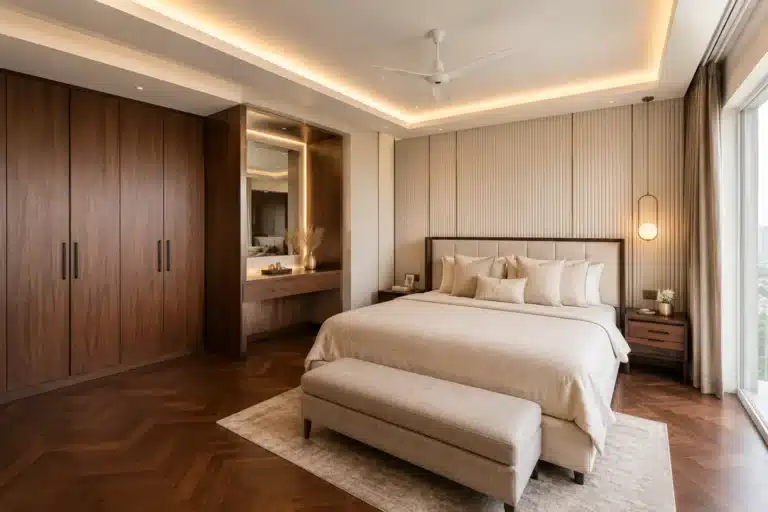
The Bedroom Verdict: ₹3,30,000 Difference
The wardrobe alone accounts for ₹1,65,000 of the gap. The cost drivers: Vikram’s lacquer-painted shutters vs Nikhil’s laminate (₹80,000 difference), Vikram’s sensor lighting vs Nikhil’s switch-activated strip (₹8,000), and Vikram’s motorised tie rack and leather-lined drawer vs Nikhil’s standard equivalents (₹25,000).
Here’s the thing nobody talks about: The wardrobe doors are closed 99% of the time. The internal differences — sensor lighting, leather lining, motorised racks — are invisible to everyone except the homeowner. The external finish (lacquer vs laminate) is the only visible difference, and it’s subtle.
Both wardrobes use the same internal layout. Same number of shelves, drawers, and hanging sections. Same loft design. Same functional capacity. Nikhil’s wardrobe stores exactly as many clothes, as efficiently, as Vikram’s. The difference is entirely about feel — and you feel it 4–6 times a day when you open and close the doors.
Room 5: Bathrooms — The Luxury Tax Nobody Expects
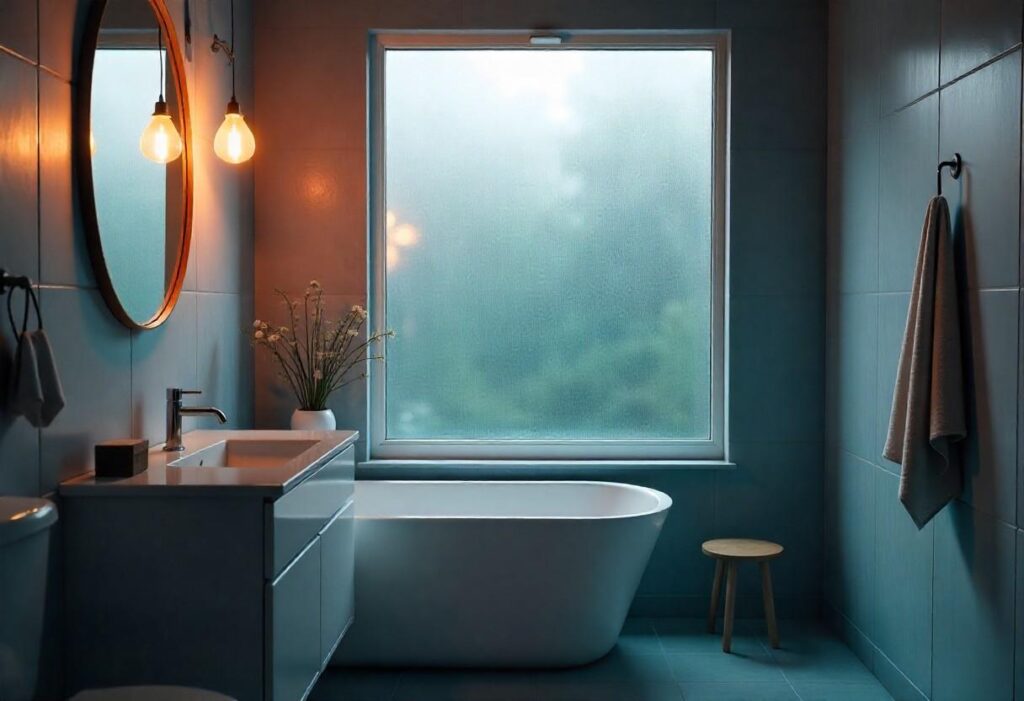
Bathroom design is the most underestimated cost multiplier in any interior project. It’s also the room where premium vs budget is most visible to guests — because bathroom fittings are out in the open, not hidden inside cabinets.
The Comparison
| Component | Vikram (per bathroom) | Nikhil (per bathroom) |
| Shower panel/mixer | Grohe Rainshower system (₹42,000) | Jaquar overhead rain shower (₹12,000) |
| Basin + vanity | Imported stone-top vanity with Villeroy & Boch basin (₹65,000) | Indian quartz-top vanity with Hindware basin (₹22,000) |
| Toilet | Wall-hungDERA concealed cistern (₹38,000) | Wall-hung Indian brand concealed cistern (₹15,000) |
| Tiles | Imported porcelain, large-format (₹350/sq ft) | Indian ceramic, large-format same pattern (₹120/sq ft) |
| Accessories | Grohe towel bars, soap dish, robe hook set (₹18,000) | Jaquar matching set (₹6,000) |
| Mirror + cabinet | Backlit anti-fog mirror with concealed cabinet (₹25,000) | Same backlit mirror, surface-mounted cabinet (₹12,000) |
| Per Bathroom | ₹1,88,000 | ₹67,000 |
| × 4 Bathrooms | ₹7,52,000 | ₹2,68,000 |
The Bathroom Verdict: ₹4,84,000 Total Difference
This is the room where the budget gap is hardest to disguise. Vikram’s Grohe fixtures have a weight and precision that Jaquar — excellent as it is — doesn’t match. His Villeroy & Boch basin has a porcelain quality and glaze depth that Indian brands can’t replicate. His imported tiles have a consistency and surface texture that domestic alternatives lack at close inspection.
However: Nikhil’s bathrooms are beautiful. The large-format tiles (same pattern, Indian production) create the same visual continuity. The wall-hung toilets create the same floating, modern aesthetic. The backlit mirrors provide the same ambient glow.
The design trick: We used the same tile from floor to wall in Nikhil’s bathrooms — creating a material-drenching effect that reads as intentionally premium even though the tile is Indian-made. When one material covers every surface seamlessly, the eye registers “luxury” regardless of the tile’s country of origin.
The Complete Cost Comparison: Every Rupee, Side by Side
| Area | Vikram (₹40L) | Nikhil (₹16L) | Difference (₹) |
| Modular Kitchen | 9,80,000 | 3,65,000 | 6,15,000 |
| Living + Dining Room | 6,20,000 | 2,45,000 | 3,75,000 |
| Master Bedroom | 5,40,000 | 2,10,000 | 3,30,000 |
| Secondary Bedrooms (×3) | 7,65,000 | 3,50,000 | 4,15,000 |
| Bathrooms (×4) | 7,52,000 | 2,68,000 | 4,84,000 |
| Pooja Room | 85,000 | 38,000 | 47,000 |
| Foyer + Shoe Unit | 45,000 | 22,000 | 23,000 |
| Painting (Full Apartment) | 92,000 | 92,000 | 0 |
| Electrical (Light Points + Fixtures) | 68,000 | 55,000 | 13,000 |
| Soft Furnishings + Curtains | 85,000 | 28,000 | 57,000 |
| Loose Furniture (Dining Table, Beds) | Provided separately by client | Provided separately by client | — |
| TOTAL | ₹40,32,000 | ₹15,73,000 | ₹24,59,000 |
What This Means for You: The Material Swap Guide
Here’s the practical takeaway. Every element in your interior design exists on a spectrum from budget to premium. The visual difference between adjacent grades is small. The cost difference is large.
| Category | Premium Choice | Smart Alternative | Visual Difference | Cost Savings |
| Kitchen shutters | PU-painted (₹1,800–2,500/sq ft) | Acrylic finish (₹900–1,400/sq ft) | Subtle — depth of colour under certain lighting | 35–45% |
| Countertop | Imported quartz (₹850–1,500/sq ft) | Indian engineered quartz (₹400–700/sq ft) | Minimal — same patterns available domestically | 40–55% |
| Kitchen hardware | Blum (Austrian, ₹8,000–15,000 per drawer set) | Hettich (German, ₹4,000–8,000 per drawer set) | None visible. Tactile difference only | 40–50% |
| Feature wall | Italian porcelain/stone slab | Back-painted glass + fluted panel | Moderate at close range. Identical at 6ft+ | 65–75% |
| Wardrobe finish | Lacquer/PU paint | High-pressure laminate | Subtle — sheen and colour depth | 35–50% |
| Bathroom fittings | Grohe/Villeroy & Boch/Duravit | Jaquar/Hindware/Parryware | Moderate — weight and finish quality | 55–70% |
| Wallpaper | Imported (Italian/Korean) | Indian-manufactured (same patterns) | Minimal — texture weight differs slightly | 60–75% |
| Sofa upholstery | Italian leatherette/imported fabric | Premium Indian leatherette/domestic fabric | Moderate — ageing and wear patterns differ | 40–50% |
| Curtains | Motorised, imported fabric | Manual, Indian fabric (same weave weight) | None visually. Convenience difference only | 65–75% |
| False ceiling | Same. Gyproc is Gyproc | Same | Zero | 0% |
| Paint | Same brand, same shade | Same | Zero | 0% |
| Lighting temperature | Same. LED is LED | Same | Zero | 0% |
How Elegante Approaches Different Budgets
We don’t have a “luxury team” and a “budget team.” The same designers who planned Vikram’s ₹40 lakh apartment planned Nikhil’s ₹16 lakh apartment. The design thinking is identical. The material selection differs.
Here’s our honest recommendation for Bangalore homeowners at different budget levels:
₹8–12 lakhs (4BHK standard): Focus everything on the kitchen and master bedroom. Simple wardrobes in secondary bedrooms. Minimal false ceiling. Good hardware (Hettich minimum). This delivers a functional, well-designed home that will serve you well for 8–10 years.
₹14–20 lakhs (4BHK smart-premium — Nikhil’s range): Full-home design with strategic material allocation. Premium finishes in daily-use rooms, simplified finishes in low-use rooms. Hettich or equivalent hardware throughout. This is the sweet spot for most Bangalore IT professionals.
₹25–40 lakhs (4BHK luxury — Vikram’s range): Premium materials across every room. Blum hardware. PU or lacquer finishes. Imported stone and fixtures. Motorised elements. This is for homeowners who want the tactile experience of premium materials in every interaction, every day.
₹40 lakhs+ (4BHK ultra-luxury): Imported everything. Custom furniture. Bespoke joinery. Integrated smart home. Interior styling with curated art and objects. For homes where the interiors are an expression of personal identity, not just functional design.
Frequently Asked Questions
How much does a 4BHK interior design cost in Bangalore in 2026?
A 4BHK interior design in Bangalore (1,800–2,500 sq ft) typically costs between ₹12 lakhs (standard) and ₹40 lakhs+ (luxury), depending on material quality, hardware brand, design complexity, and the level of customisation. At Elegante, our 4BHK projects range from ₹12 lakhs to ₹45 lakhs, with most clients in the ₹15–25 lakh range.
Can a ₹15 lakh interior really look like a ₹40 lakh interior?
From a design perspective — colour palette, spatial planning, lighting, ceiling profiles, and furniture layout — yes, it can look remarkably similar. The differences emerge in material quality (countertop grade, shutter finish, hardware brand) and in tactile details (how a drawer glides, how a tap feels in your hand). At a visual level, smart material substitution and consistent design language can close 80% of the perceived gap.
What’s the single biggest money-saver in interior design?
Strategic room allocation. Concentrate your premium spend on the kitchen, living room, and master bedroom — the rooms you use 90% of the time. Simplify finishes in guest bedrooms, children’s rooms, and utility areas. This single strategy can reduce total project cost by 25–35% without visibly affecting overall design quality.
Is Hettich hardware good enough, or should I go for Blum?
Both are German-engineered, premium-quality brands. Hettich is excellent — rated for 50,000+ cycles with a 10-year warranty. Blum is a tier above in smoothness, dampening quality, and innovation (touch-to-open, servo-drive). For most Bangalore homeowners, Hettich is the right choice — it delivers 95% of Blum’s performance at 50–60% of the cost. We use Hettich as our standard across all Elegante projects and upgrade to Blum for clients who specifically want the absolute best.
How long does a 4BHK interior design take in Bangalore?
At Elegante, a standard 4BHK project takes 50–65 days. A premium/luxury 4BHK with extensive customisation takes 65–90 days. Vikram’s ₹40 lakh project took 78 days. Nikhil’s ₹16 lakh project took 52 days (simpler finishes and fewer custom elements).
Does Elegante serve all areas in Bangalore for 4BHK projects?
Yes. We’ve completed 4BHK and villa projects across Whitefield, Koramangala, Indiranagar, HSR Layout, Sarjapur Road, JP Nagar, Hebbal, Yelahanka, Electronic City, Bannerghatta Road, Hennur, Marathahalli, Jayanagar, and 80+ other Bangalore neighbourhoods.
Your 4BHK Transformation Starts With One Question
Whether your budget is ₹12 lakhs or ₹45 lakhs, the design conversation starts the same way: what kind of home do you want to live in?
We’ll handle the rest — the material decisions, the budget allocation, the trade-offs, and the tricks that make a ₹16 lakh home feel like a ₹40 lakh one.
Book Your Free Design Consultation →
Or call us: +91 97414 72791
Or use our Price Calculator for an instant 4BHK estimate.
Elegante Interiors is a Bangalore-based luxury interior design firm with its own modular manufacturing facility. We serve 80+ Bangalore neighbourhoods with residential and commercial interior design, backed by a 15-year warranty on all modular products.
Explore Our Portfolio → | View All Services → | Read More Blogs →