
By the Design Team at Elegante Interiors | 14 Years Combined Experience | Last Updated: May 2026
We’ve surveyed over 300 Bangalore apartments across Whitefield, Koramangala, HSR Layout, Electronic City, and Sarjapur Road over the past two years. We’ve photographed their pooja rooms. We’ve checked their Vastu alignment. We’ve noted every material choice, every idol placement, every colour decision.
The result: 9 out of 10 apartments had at least one critical Vastu violation in their pooja setup.
Not minor quibbles. Real violations — the kind that Vastu Shastra says directly disrupts the flow of spiritual energy through your home. Placement against bathroom walls. Idols facing the wrong direction. Dark wood absorbing light instead of reflecting it. Broken murtis still on the shelf. Storage above the deity. The pooja room doubling as a store room.
And here’s what makes it worse: most of these families had no idea they were doing it wrong. They’d hired an interior designer, or bought a ready-made mandir online, or simply placed the pooja unit wherever the builder left a niche — and assumed it was fine.
It wasn’t.
At Elegante Interiors, we’ve designed over 500 pooja rooms across Bangalore. Some in dedicated rooms. Some in foyer niches. Some in compact 2BHK apartments where space is measured in inches, not feet. Every single one is Vastu-compliant. And every single one was delivered for under ₹50,000.
This blog is a complete breakdown of the 7 most common pooja room mistakes we see in Bangalore apartments, why they matter according to Vastu Shastra, and the exact fix for each one — with real costs.
If you have a pooja room in your home right now, you’ll want to check it against this list before you finish reading.

But First — Why Does Pooja Room Vastu Actually Matter?
Let’s address this directly.
Whether you follow Vastu Shastra as a spiritual practice or simply as a design philosophy, the principles behind pooja room placement are rooted in something practical: the relationship between space, light, energy flow, and human psychology.
The northeast corner of a home receives the first morning sunlight. East-facing prayer positions mean you’re facing the direction of sunrise — which every culture on earth associates with new beginnings, clarity, and positive energy. Light colours reflect natural light and create a sense of calm. Clutter-free spaces reduce visual noise and improve focus during meditation.
Vastu isn’t magic. It’s spatial intelligence codified over thousands of years.
When your pooja room violates these principles — wrong direction, wrong colours, wrong placement relative to bathrooms or bedrooms — the space doesn’t feel peaceful. You don’t feel drawn to it. Daily prayer becomes a chore instead of a ritual. The room gathers dust instead of devotion.
And that defeats the entire purpose of having a sacred space in your home.
Now, let’s look at the 7 mistakes that are silently ruining pooja rooms across Bangalore.

Mistake #1: Placing the Pooja Room in the South or Southwest Corner
How common is this? Extremely. We see it in roughly 4 out of every 10 Bangalore apartments we survey.
Why it happens: Builders design floor plans for maximum living space, not for Vastu compliance. The “pooja niche” — if one exists at all — gets placed wherever there’s leftover space. In most modern Bangalore apartment layouts, that leftover space ends up in the south or southwest quadrant because the living room takes the north-east, bedrooms take the south-east and north-west, and the kitchen takes the south-east or north-west.
The pooja room gets whatever is left. And whatever is left is usually wrong.
Why it’s a problem according to Vastu: The southwest is associated with the earth element — stability, grounding, materiality. It’s the ideal zone for the master bedroom (rest, weight, heaviness). The northeast, on the other hand, is associated with water and divine energy — it’s the zone of clarity, spirituality, and the highest concentration of positive cosmic energy.
Placing a pooja room in the southwest is like trying to meditate in a room designed for sleeping. The energies conflict. Vastu Shastra holds that this misalignment can lead to restlessness, financial instability, and disrupted family harmony.
The Elegante Fix (Under ₹50K):
If your apartment’s builder-designated niche is in the southwest and you can’t create a dedicated pooja room in the northeast, here’s what we do:
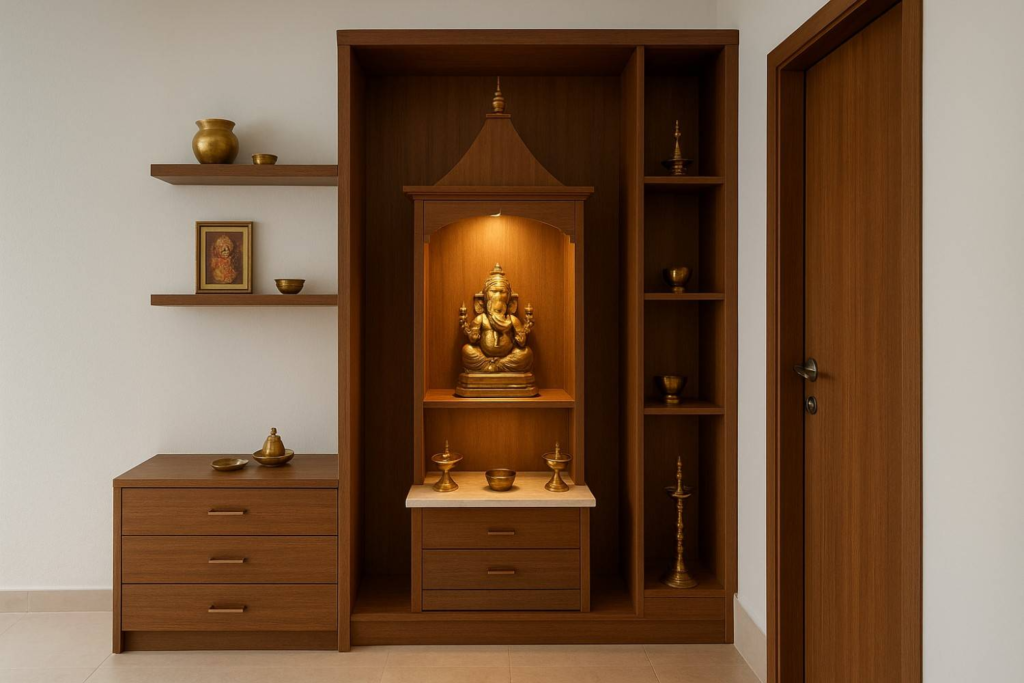
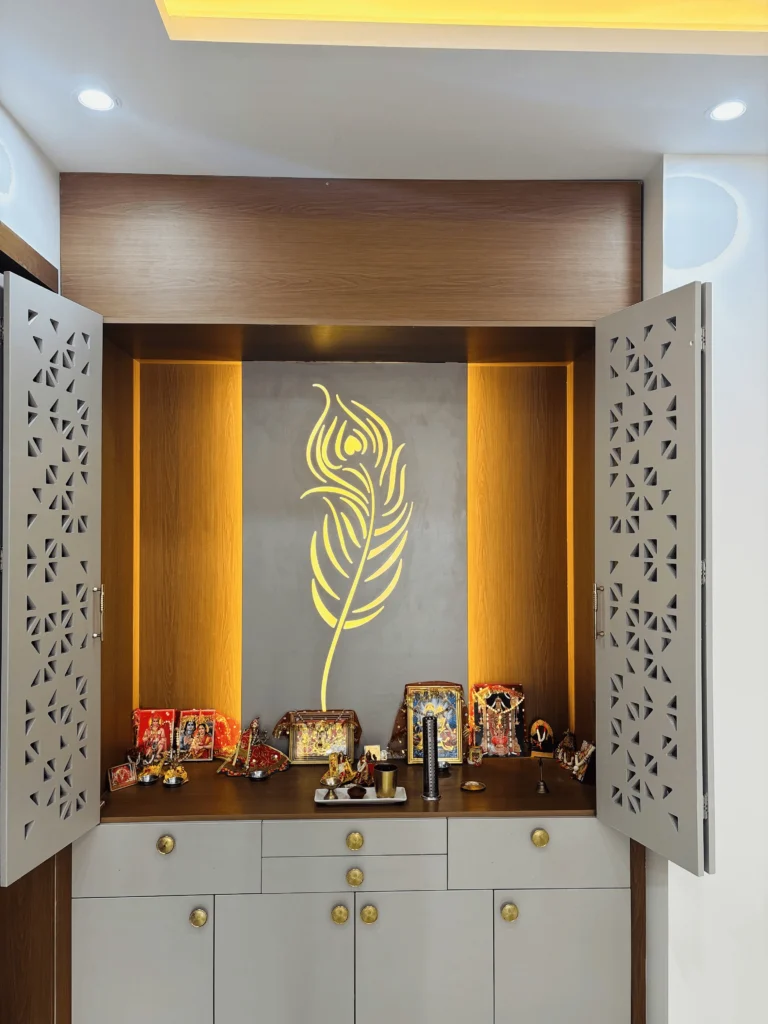
Option A — Relocate to the northeast corner of your living room (₹18,000–₹35,000) We design a wall-mounted modular mandir unit in the northeast corner of the living room. CNC-cut jaali panels create visual separation from the living space without building a wall. The unit includes an idol shelf at chest height, LED backlight behind the jaali for a warm devotional glow, and a pull-out drawer for daily pooja accessories.
This solution works in apartments where a full room relocation isn’t possible which is most Bangalore apartments.
Option B — Convert a foyer niche to a northeast-oriented pooja space (₹22,000–₹42,000) Many Bangalore apartments have a foyer or entryway niche that’s either unused or filled with a shoe rack. If this niche falls in the northeast or east zone of the apartment, we convert it into a dedicated pooja unit with a wooden frame, backlit panel, and concealed storage below.
Real cost from a recent Elegante project: A family in a 3BHK in HSR Layout had their builder-provided pooja niche in the southwest. We designed a wall-mounted teak-finish mandir unit in the northeast corner of their living room. Total cost: ₹28,000 including CNC jaali, LED strip, shelf, drawer, and installation. Completed in 2 days.
Mistake #2: The Pooja Room Shares a Wall With the Bathroom
How common is this? Alarmingly common in compact Bangalore apartments. We estimate 3 out of 10 apartments have this issue.
Why it happens: In 2BHK and 3BHK layouts between 800–1,400 sq ft, space is tight. The builder places the bathroom and the pooja niche on opposite sides of the same wall because it’s structurally efficient. The homeowner doesn’t check the floor plan for this adjacency — they see a “pooja niche” on the layout and assume it’s been thoughtfully placed.
It hasn’t. It’s been conveniently placed.
Why it’s a problem according to Vastu: This is one of the most serious Vastu violations for a pooja room. The bathroom is associated with impurity and the disposal of waste. Placing the most sacred space in your home against the same wall as the most impure space creates an energetic contradiction that Vastu Shastra considers deeply inauspicious.
Beyond Vastu, there’s a practical issue: bathroom plumbing vibrations and water sounds transmit through shared walls. You hear flushes during evening aarti. That’s not a spiritual environment.
The Elegante Fix (Under ₹50K):
If you can’t relocate the pooja unit: We install an acoustic-insulated backing panel behind the mandir — a 12mm acoustic board sandwiched between the wall and the pooja unit frame. This doesn’t solve the Vastu concern entirely, but it eliminates sound transmission and creates a physical separation layer.
We then add a copper Vastu pyramid behind the mandir (a traditional remedy recommended by Vastu consultants) and enhance the space with warm lighting and natural material finishes (teak wood, brass accents) to strengthen the sacred character of the space.
Cost: ₹8,000–₹15,000 for acoustic backing + Vastu remedial elements.
If you can relocate (recommended): We move the pooja unit to a non-shared wall in the northeast or east zone. This is the solution we recommend in every case where it’s feasible. A new wall-mounted or niche-embedded unit costs ₹22,000–₹40,000 depending on size, material, and design complexity.

Mistake #3: Using Dark Wood That Absorbs Light Instead of Reflecting It
How common is this? This is the single most common design mistake present in roughly 6 out of 10 Bangalore pooja rooms we’ve surveyed.
Why it happens: Indian families have a deep cultural association between dark wood and pooja rooms. Rosewood mandirs. Walnut-finish cabinets. Dark teak carvings. These materials feel “traditional” and “authentic.” So when families go shopping for a pooja unit whether online or at a furniture store on Mysore Road they gravitate toward the darkest, most ornate option.
The intention is right. The outcome is wrong.
Why it’s a problem according to Vastu: Vastu Shastra explicitly recommends light colours for the pooja room — whites, creams, light yellows, soft pastels, and natural light wood tones. These colours reflect light, create a sense of spaciousness, and foster the meditative calm that a sacred space requires.
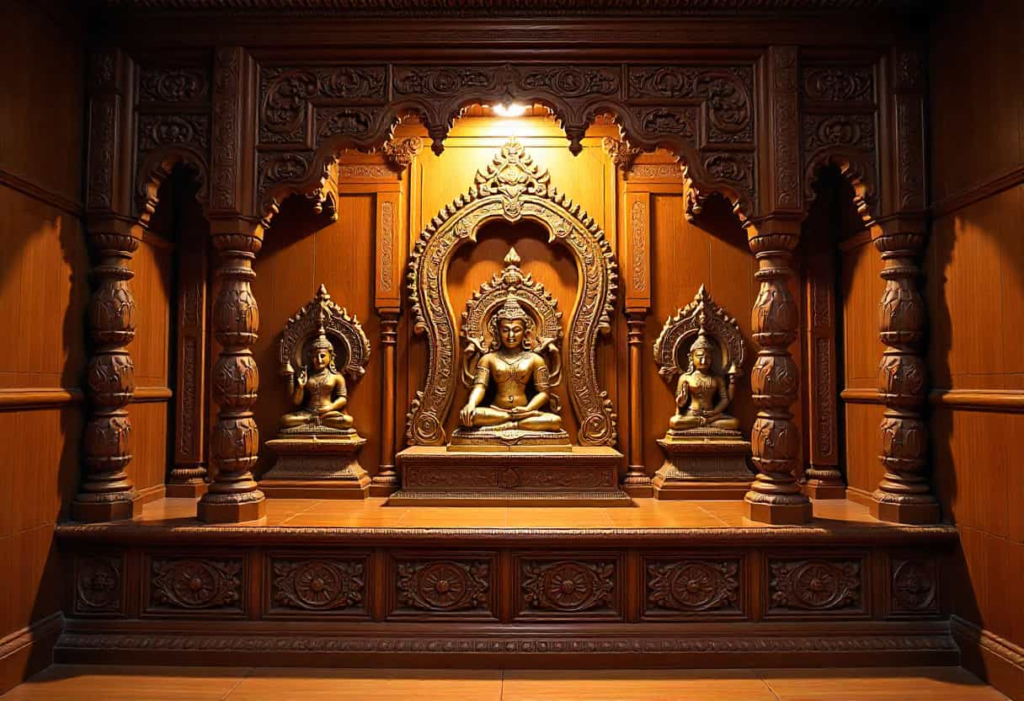
Dark colours — black, deep brown, dark walnut, deep maroon — absorb light and create visual heaviness. In Vastu terms, they harness “negative” or “heavy” energy that is counterproductive to prayer and meditation. In practical design terms, they make a small pooja space feel cramped, cave-like, and uninviting.
This matters doubly in Bangalore apartments where pooja “rooms” are often 3×3 ft niches with no natural light. A dark wood mandir in a small, lightless niche is the fastest way to create a space that nobody wants to use.
The Elegante Fix (Under ₹50K):
We design pooja units in light wood tones with strategic backlighting a combination that honours the traditional wooden aesthetic while meeting Vastu’s light-and-brightness requirements.
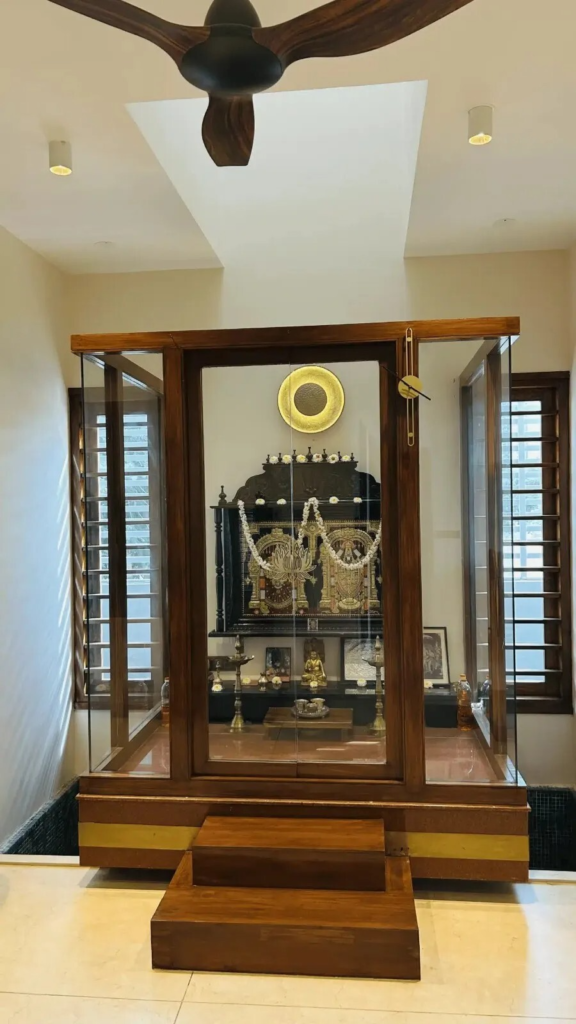
Our recommended palette for pooja units:
| Material/Finish | Vastu Compliance | Visual Effect | Cost Range |
|---|---|---|---|
| Light Oak laminate | Excellent — warm, light, reflective | Modern-traditional hybrid. Works in any apartment style | ₹15,000–₹30,000 |
| Teak wood (natural light finish, not stained dark) | Excellent — traditional and auspicious | Classic Indian aesthetic with natural warmth | ₹20,000–₹50,000 |
| White PU-painted MDF with gold/brass accents | Excellent — maximum light reflection | Contemporary, clean, pairs with modern interiors | ₹18,000–₹35,000 |
| Engineered wood with light maple veneer | Good — light and natural | Budget-friendly, visually warm | ₹10,000–₹22,000 |
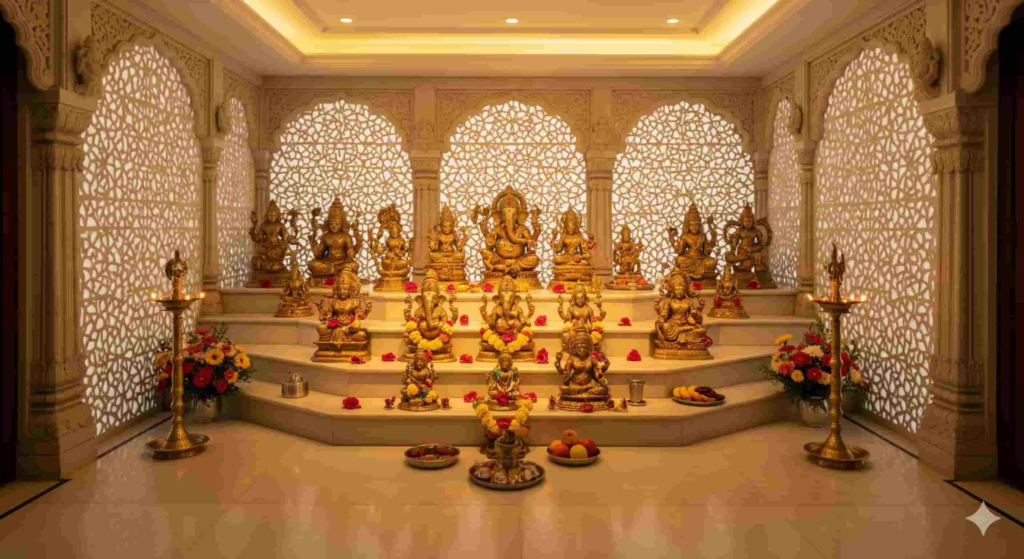
What about families who already own a dark wood mandir? You don’t need to replace it. We add two modifications:
- LED backlight strip (warm amber, 2700K) installed behind the unit or behind a jaali panel — floods the space with warm golden light that counteracts the visual heaviness of dark wood. Cost: ₹2,500–₹5,000.
- Light-coloured wall behind the mandir — repaint the wall directly behind the pooja unit in White Essence or Pale Cream. The contrast between the dark mandir and the bright wall creates depth and prevents the space from feeling like a dark cave. Cost: ₹1,500–₹3,000.
Combined fix for existing dark mandirs: ₹4,000–₹8,000. This is the highest-impact, lowest-cost Vastu correction you can make in your entire home.
Mistake #4: Idols Placed Wrong — Wrong Height, Wrong Direction, Wrong Quantity
How common is this? Present in roughly 7 out of 10 homes, making this the second most common mistake after dark wood.
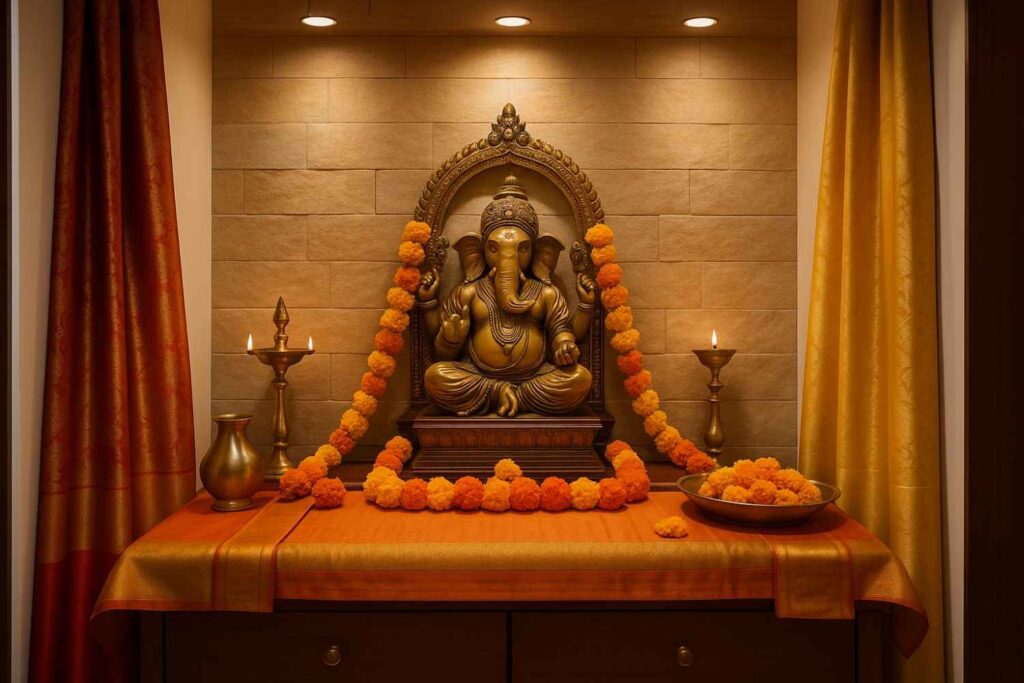
Why it happens: Families accumulate idols and deity photos over decades — gifts from relatives, souvenirs from temple visits, heirlooms from grandparents. Every new addition goes onto the shelf. Nobody checks direction. Nobody checks height. Nobody checks if two idols of the same deity are sitting next to each other (a specific Vastu violation).
The pooja shelf becomes a crowded, unorganised collection rather than a curated spiritual space.
What Vastu Shastra says about idol placement:
There are clear guidelines, and most Bangalore apartments violate at least two of them:
| Vastu Rule | What Most People Do Wrong |
|---|---|
| Idols should face East or West, so you face East or North while praying | Idols face random directions based on where the shelf was mounted |
| Idols should be at chest height when you’re seated | Idols placed too high (above head) or too low (floor level) — both are incorrect |
| Idols should be 2–3 inches away from the wall | Idols pushed flush against the wall, blocking air circulation around them |
| Avoid keeping two idols of the same deity | Families commonly have 2–3 Ganesha murtis from different sources |
| Broken or cracked idols should be removed respectfully | Chipped idols remain on the shelf for years out of emotional attachment |
| Nothing should be stored above the idol | Shelves above the idol hold books, matchboxes, oil bottles, random storage |
Mistake #5: No Door, No Separation, No Sacred Boundary
How common is this? Roughly 5 out of 10 open-concept pooja setups in Bangalore apartments.
Why it happens: Modern interior design trends favour open floor plans. Walls come down. Doors disappear. The pooja “room” becomes a pooja “corner” — a shelf on a living room wall with no visual or physical separation from the TV, the sofa, and the daily chaos of family life.
Open concept works beautifully for kitchens and living rooms. It doesn’t work for sacred spaces.
Why it’s a problem according to Vastu: Vastu Shastra recommends that the pooja room have a two-door entrance — traditionally wooden doors, ideally with carved motifs. The doors serve a specific Vastu purpose: they contain the spiritual energy generated during prayer within the sacred space, preventing it from dissipating into the broader living area.
Even Vastu consultants who are flexible on door count agree on one principle: there must be a defined boundary between the sacred space and the secular space. Without it, the spiritual energy of the pooja room mixes with the chaotic energy of the living area, diluting both.
Beyond Vastu, there’s a psychological reality: you can’t shift into a meditative, devotional headspace when you’re staring at the TV remote and your kid’s school bag. Sacred spaces need containment.
Mistake #6: Using the Pooja Room as a Storage Dump
How common is this? More than you’d think roughly 4 out of 10 homes.
Why it happens: Bangalore apartments are space-starved. A dedicated pooja room — if one exists — is typically the smallest room in the house: 25–40 sq ft. It’s the only room not being actively “used” for 23 hours a day. So it becomes the default destination for things that don’t have a home: festival decorations, old photo frames, spare bedsheets, suitcases, Diwali lights, Holi colours.
The pooja room becomes a store room with a god on the shelf.
Why it’s a problem according to Vastu: Clutter blocks energy flow. That’s not just Vastu philosophy — it’s a principle supported by environmental psychology. A cluttered space increases cortisol (the stress hormone) and reduces the brain’s ability to focus and achieve calm.
Vastu Shastra is explicit: the pooja room should be the cleanest, most clutter-free space in the home. Nothing unrelated to worship should be stored in or near the pooja area. Heavy furniture, luggage, and storage items carry “heavy” energy that weighs down the spiritual lightness of the space.
The Elegante Fix (Under ₹50K):
Step 1: Remove everything that isn’t related to daily worship. Festival items go into a bedroom loft. Old frames go into storage. Suitcases go under the bed or into a utility closet.
Step 2: Build smart, concealed storage INTO the pooja unit. This is what we do at Elegante — and it’s one of the most appreciated design details in every project.
Our pooja units include:
- A pull-out drawer at the base for incense sticks, camphor, matchboxes, kumkum, agarbatti holders — the daily-use items that currently clutter the shelf
- A concealed shelf behind a lower panel for pooja thali, festival-specific items, and oil/ghee bottles
- Hooks inside the unit frame for hanging garlands or mala beads
Everything has a designated place. Nothing sits on the idol shelf except the idols. The result: a space that’s organised, clean, calming, and Vastu-compliant.
Cost for a storage-integrated pooja unit: ₹20,000–₹45,000 (this is the full unit cost — storage is integrated into the design, not an add-on).
Frequently Asked Questions
What is the best direction for a pooja room as per Vastu?
The northeast corner of your home is considered the most auspicious direction for a pooja room according to Vastu Shastra. If northeast isn’t available in your apartment layout, East and North are the next best options. Avoid placing your pooja room in the South, Southwest, or directly beneath a staircase. At Elegante, we do a complete Vastu mapping of your apartment before recommending placement.
Can I have a pooja room in my bedroom as per Vastu?
Vastu Shastra advises against having a pooja room inside a bedroom. However, if space constraints make this unavoidable — common in compact Bangalore apartments — place the mandir in the northeast corner of the room, ensure your feet don’t point toward the mandir while sleeping, and keep the mandir covered with a light-coloured drape when not in use. A fabric curtain on a wooden frame creates the necessary sacred boundary.
How much does a Vastu-compliant pooja room cost in Bangalore?
A wall-mounted Vastu-compliant mandir starts at approximately ₹18,000–₹27,000 at Elegante Interiors, including the unit, lighting, and installation. A niche-embedded unit with doors and full lighting costs ₹35,000–₹46,500. A full dedicated pooja room design with false ceiling and flooring ranges from ₹50,000–₹75,000. All prices include design consultation, Vastu mapping, manufacturing, and installation.
What colours are recommended for a pooja room as per Vastu?
Light and soothing colours are recommended — white, cream, light yellow, pale blue, and soft pastels. These colours reflect light and create the calm, meditative atmosphere that Vastu prescribes for sacred spaces. Avoid dark colours like black, deep brown, or dark red on walls or the mandir unit. If your mandir is dark wood, compensate with a light wall behind it and warm LED backlighting.
Is it bad Vastu to have a pooja room next to the kitchen?
The kitchen (associated with fire element) is not ideal next to the pooja room, but it’s not as serious a violation as a bathroom-adjacent pooja room. If your pooja room is near the kitchen, ensure it doesn’t share a direct wall with the stove/hob area, and maintain the pooja space as a clearly defined separate zone with its own boundary (doors or partition).
What should never be kept in a pooja room?
According to Vastu, the following should never be in your pooja room: broken or cracked idols, photos of deceased family members, storage items unrelated to worship (suitcases, boxes, old furniture), heavy furniture, dark drapes, and anything above the idol shelf (no storage above the deity level). The pooja room should be the most clutter-free space in your home.
Can Elegante fix my existing pooja room for Vastu compliance?
Yes. We offer standalone pooja room redesign services — you don’t need to be doing a full-home interior project. We’ll assess your current setup, identify Vastu violations, and design a fix that works within your space and budget. Quick fixes (lighting + idol arrangement + wall colour) can be done for under ₹10,000. A complete unit replacement with Vastu mapping typically costs ₹18,000–₹45,000.
Do you design pooja rooms for all Bangalore areas?
Yes. We serve all Bangalore neighbourhoods including Whitefield, Koramangala, HSR Layout, Electronic City, Sarjapur Road, JP Nagar, Indiranagar, Jayanagar, Hebbal, Marathahalli, Yelahanka, Bannerghatta Road, Hennur, and 80+ other localities. Standalone pooja room projects are typically completed within 5–7 days from consultation to installation.
Your Pooja Room Deserves Better Than “Good Enough”
The pooja room is the spiritual heartbeat of your home. It’s where your family starts the day. It’s where you seek calm after a long commute down the Outer Ring Road. It’s where your children learn the rituals that connect them to generations before them.
It deserves more than a builder niche and a bare light bulb.
It deserves intention. Direction. Light. Beauty. And yes — Vastu.
All of that is possible for under ₹50,000. And it starts with a single conversation.
Book Your Free Pooja Room Consultation →
Or call us: +91 97414 72791
Or use our Price Calculator for an instant estimate.